

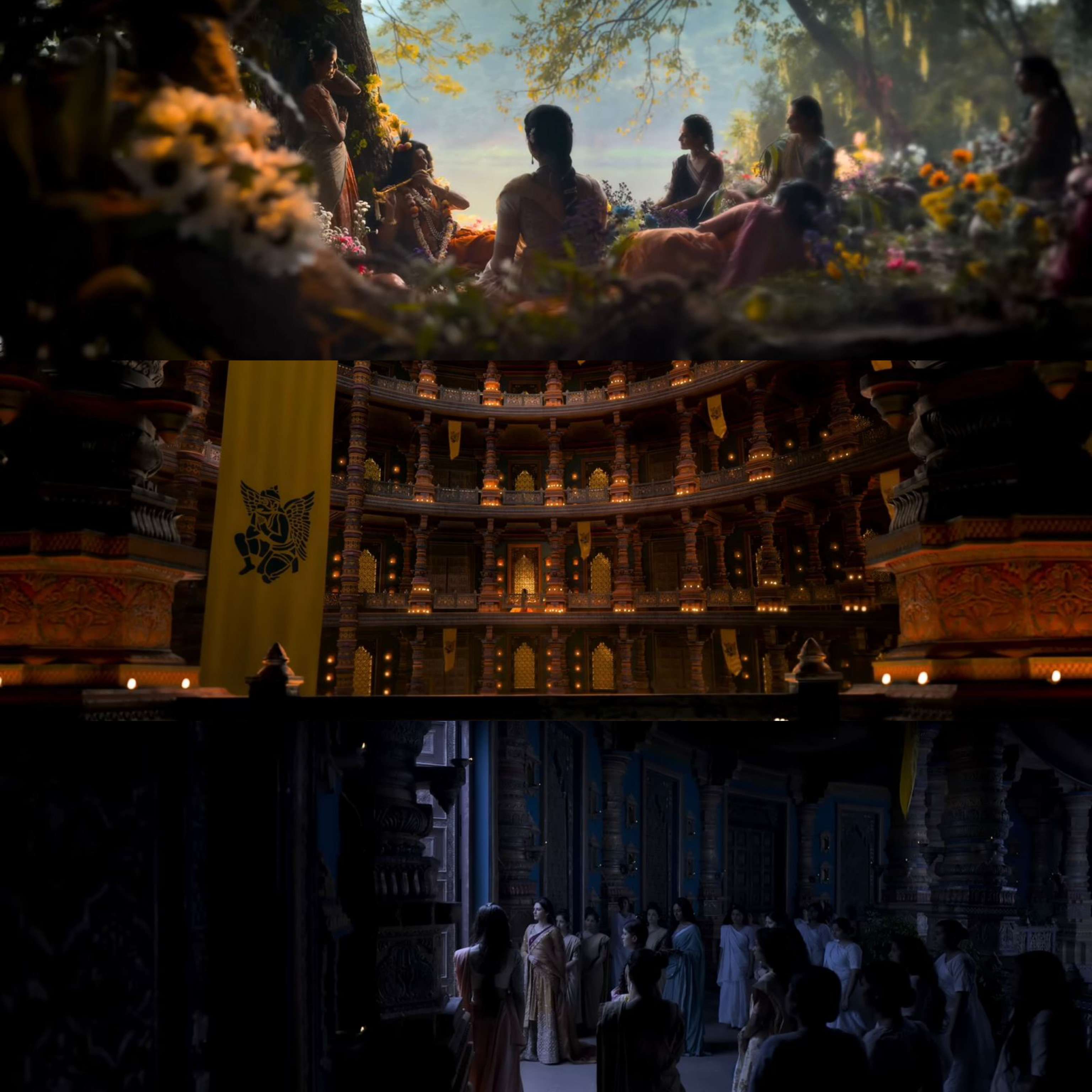
The overwhelming response to the Krishnavataram trailer and its music drop hasn’t just been about scale—it’s been about craft. Beneath the spectacle lies a meticulously orchestrated collaboration between some of the most accomplished technicians working today. At the center of this achievement are cinematographer Ayananka Bose, production designer Chokas Bhardwaj, and costume designer Nidhi Yasha—all unified under the sharply defined vision of director Hardik Gajjar.
What emerges from their collaboration is not just visual brilliance, but a cohesive aesthetic language that feels both mythic and modern—an achievement that signals a new benchmark in Indian cinematic storytelling.
Hardik Gajjar: The Architect of Excellence
At the heart of this collaboration is Hardik Gajjar’s direction. His greatest achievement lies not just in conceptualizing Krishnavataram, but in assembling and orchestrating this exceptional team and briefing them with razor sharp clarity of vision..
Gajjar demonstrates a clear understanding of each department’s strengths and allows his collaborators the creative freedom to excel while ensuring alignment with his overarching vision. His approach is neither authoritarian nor hands-off; it is deeply collaborative, rooted in trust and clarity.
By bringing together highly capable talents across all dimensions of the film, he has effectively curated a team that elevates each other’s work. This ability to recognize, unify, and channel talent is what transforms a film from good to extraordinary.
Ayananka Bose: Painting Mythology with Light
Ayananka Bose’s cinematography in Krishnavataram doesn’t merely capture images—it interprets mythology through light, texture, and movement. Known for his ability to create immersive visual worlds, Bose approaches this film with a painter’s sensitivity and a technologist’s precision and brings a visual language that feels expansive without becoming overwhelming. There’s a clear control over light and shadow—frames that feel sculpted rather than simply lit.
In the trailer, even the larger-than-life moments don’t tip into excess as he cautiously resists the temptation of overindulgence. Wide shots carry weight, but close-ups retain intimacy. That balance is crucial in a film dealing with mythological material, where the risk is often to lean too heavily into grandeur at the cost of emotional clarity.
The trailer reveals a striking interplay of chiaroscuro lighting, where divine figures emerge from darkness with almost sculptural intensity. His framing choices elevate characters into archetypes without stripping them of emotional intimacy. Whether it’s the sweeping celestial landscapes or tightly composed moments of human vulnerability, Bose ensures that every frame carries narrative weight.
Bose’s work here suggests an understanding that scale works best when it’s grounded.
More importantly, in a genre that often leans heavily on excess, his restraint becomes the defining strength—allowing the visuals to breathe, to resonate, and to linger in the viewer’s mind.
Chokas Bhardwaj: Building Worlds That Feel Eternal
If Bose gives the film its visual rhythm, Chokas Bhardwaj constructs its physical reality. The production design of Krishnavataram is nothing short of monumental, yet it never feels artificial.
Bhardwaj’s sets are rooted in cultural memory while embracing cinematic imagination. Palaces, battlefields, and sacred spaces are designed with an acute understanding of spatial storytelling—each environment reflecting the emotional and philosophical undercurrents of the narrative.
Textures play a crucial role: weathered stone, intricate carvings, layered fabrics, and expansive terrains all contribute to a tactile authenticity. His work bridges the gap between mythology and lived reality, making the world of Krishnavataram feel both timeless and immediate.
What stands out most is his ability to collaborate seamlessly with cinematography and costume. His sets don’t compete for attention; they amplify the performances and visual tone, creating a unified canvas.
Nidhi Yasha: Costumes as Character and Culture
Costume design in mythological cinema often risks becoming ornamental. Nidhi Yasha avoids this pitfall by treating costumes as extensions of character psychology and cultural identity.
Each look in Krishnavataram appears deeply researched yet imaginatively reinterpreted. The silhouettes, color palettes, and fabric choices reflect not just historical influences but narrative arcs. Divine characters are distinguished not only by grandeur but by subtle symbolic detailing—embroidery, draping styles, and color transitions that evolve with the story. It is interesting to notice the difference in texture and detail of the costumes of rural Radha versus regal Rukmini and Bhama. Hand painted surfaces along with hand embroidery create a mesmerising and highly artistic take on the subject.
Yasha’s work also demonstrates an acute awareness of movement. The costumes are designed to interact with light and space. Whether in stillness or motion, they retain a sense of purpose and authenticity.
Individually, Bose, Bhardwaj, and Yasha are masters of their craft. Collectively, they achieve something far rarer—a seamless visual symphony. The lighting complements the sets. The sets don’t overwhelm the costumes. The costumes respond to both. There’s a shared sensibility—nothing feels like it belongs to a different film.
This synergy is evident in the trailer’s most celebrated moments.
Such harmony doesn’t happen by accident. It is the outcome of a shared creative philosophy—one that prioritizes storytelling over individual showmanship. The result is a layered visual experience where no element exists in isolation. Hardik Gajjar appears to have set a clear tone early on and stuck to it, while allowing his team enough room to interpret it within their own disciplines.
A Defining Moment in Visual Storytelling
The response to the Krishnavataram trailer and music is a testament to what happens when technical brilliance meets visionary leadership. It signals a shift in audience expectations—where spectacle alone is no longer enough, and craft becomes the true differentiator. It’s still early—trailers can only reveal so much—but the initial response suggests that Krishnavataram is being noticed not just for its ambition, but for how that ambition is being handled. If that balance carries through the full film, Krishnavataram won’t just stand out for how it looks—it’ll stand out for how well all its moving parts come together. And that, more than any single visual moment, is what tends to last.
Through the combined excellence of its cinematography, production design, and costume design, and stunning original scores by Prasad Sashte, Beautifully poetic and deeply moving lyrics by Irshad Kamil, Krishnavataram doesn’t just promise a cinematic experience—it redefines what that experience can look and feel like.
Krishnavataram Part 1: The Heart (releasing May 7, 2026) is produced by Sajan Raj Kurup and Shobha Sant of Creativeland Studios Entertainment along with Poonam Shroff and Parth Gajjar of Athashrikatha Motion Pictures.
